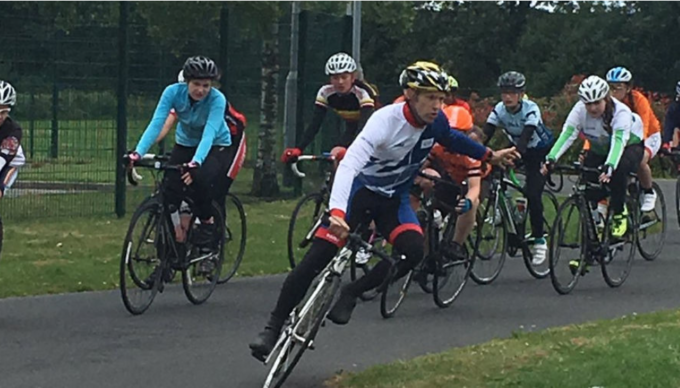
That’s the principles of rear & front position riding now is the race itself, as per the opening to this article the write up is fundamentally written and referenced for the likes of an Elimination race on Tameside or similar line Preston Arena and not the Velodrome for the tactics there are dramatically different.
The likes of Tameside differ fundamentally from the Velodrome in that on the Velodrome the shortest and therefore quickest ignoring lapping finer points, whereas at the likes of Tameside with its un-banked bends the entry line for the greatest speed, apex position and exit line means that the fastest and smoothest line around the circuit is not the shortest line i.e. along the inside edge the ‘Black line’ on the Velodrome track.
On Tameside approaching an anti-clockwise bend the lead rider will manoeuvre across to the right of the track and the riders line will be to go from this wide right approach and pass the apex of the bend very close to its inside line, from there the rider will exit at speed and naturally manoeuvre back out to the right of the track thus the bend radius will be ironed out and made greater and can be taken at greater speed.
This is to be read for sweeping bends that can be taken with some speed and fluency.
With this type of bend there are opportunities for overtaking, faster approach by a following rider into the bend and undertaking the line but this carries risk of the line cutting back across you, your apex will be a lot tighter so there is a risk of not being able to maintain tyre adhesion thus sliding or even falling. On exit you may cut across the exiting line of riders who have come through the bend of a less sharp and more speed fluent bend, therefore there maybe evasive action to avoid collision.
The second type of bend which is also at Tameside is the tight bend that requires braking and dropping through the gears. This is the type of bend that provides more race opportunities but also risks.
Play through the approach the lead rider will swing right to gain the smoothest line through the bend, as per above , and most likely have to slow down quite a bit by braking to take the sharper bend and not risk the loss of tyre adhesion.
In doing so riders 2,3,4, …… have also to take braking action and naturally being aware that there is a bend and the rider in front will be braking they start braking momentarily before you would do if they were rider one, so a ‘domino effect’ of slightly earlier braking occurs. This momentary pre braking occurs along the line and the result is similar to observing a ‘caterpillar’ buckling up tight, forming a humped back, whilst crawling along resulting in harder braking and thus slower speeds towards the rear of the line of riders.
Now rider one exits the bend and accelerates away, rider two exits but due to the aforementioned ‘pre braking’ is a touch slower through the bend, repeat, repeat, and therefore the ‘caterpillar’ now stretches out with increased spaces between its sets of legs, or in race terms between riders – so the early riders into the bend gain an advantage in exit speed and distance from following riders.
Therefore when the last of the riders come out of the bend they have to accelerate hard, and burn energy, to catch up to the other riders for the next bend, then if it not a sweeping bend the ‘caterpillar’ will come into being again. The result being the lead riders are distancing from the following riders. So repeatedly the later riders are burning up energy reserves and tiring the muscles that may need for a fast or sprint finish.
So forward thinking, forward positioning and preplanning is beneficial for the tighter corners.
John Drake
